The First Girl Guides

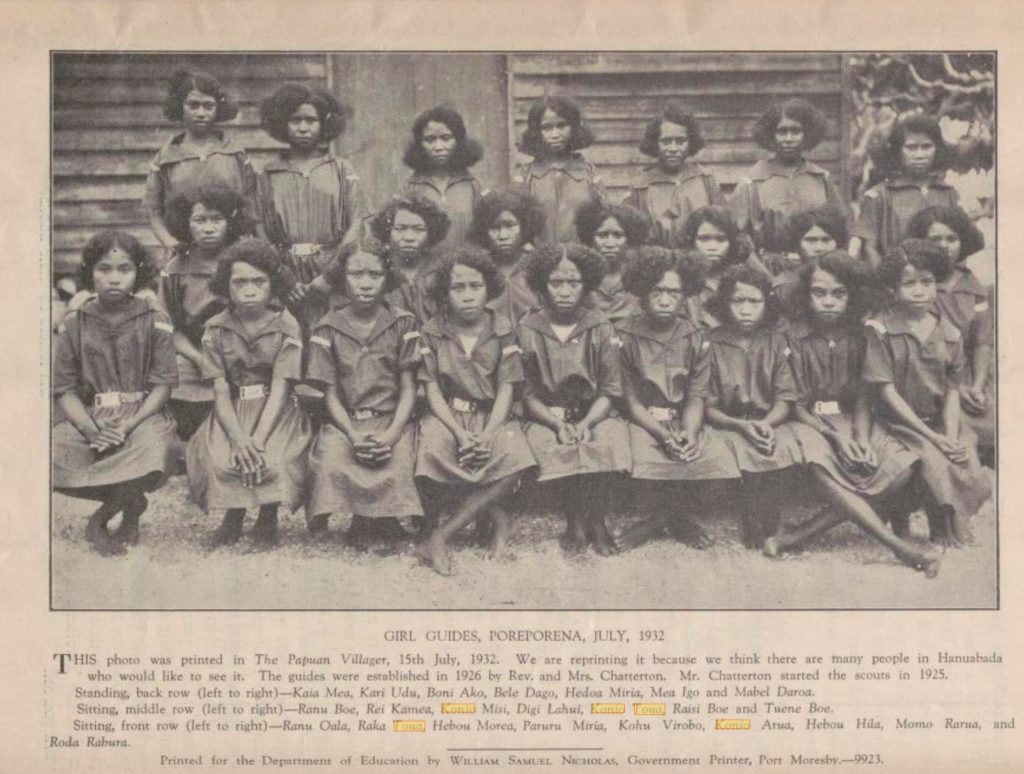
Some of you have seen this photograph circulating and, in some cases, have recognised your grandmother’s or even your great-grandmother’s face. It’s a beautiful feeling, to look into the face of someone who laid the foundation for you, and to feel that deep “tubu” bond stretching across generations.
My own grandmother (Konio Toua) is in the photo, along with her sibling (Raka Toua). I met Bubu Raka quite often (I feel old) at her House in Gunina and I last met another sibling Bubu Mala at, of all places, Sydney, when she visited her daughter, my Aunty Mary. I never had the chance to meet my grandmother herself, but the way these two sisters treated me whenever we met made me wonder just how kind and loving my own grandmother must have been.
Perhaps that’s just how life works. Some are left behind to do one last deed for us, to show us, through their kindness, how our own might have treated us had we known them.
Now, this photograph stirred my curiosity. Who was this group? What is the story behind it? And more personally, why do they all wear such serious expressions?
So I went digging.
That’s the thing about old photographs – they invite inquiry. The more you uncover, the deeper your understanding becomes, and the greater your appreciation grows for both the image and the people within it.
This photograph captures the first group of girls to join the Girl Guide movement in Papua in 1926, established by Mrs Chatterton. Four patrols were formed, each named after native birds: Pune, Kaubebe, Koki, and Bisini.
Now here’s where this photo comes alive.
I found two short writings, written by Bele Dago and Hedoa Miria, both in this Papuan Villager pic. Their words give us rare insight into the minds of these young women.
“We Poreporena girls are very pleased and happy because this great thing was born among us; also we had been taught many things.”
— Hedoa Miria, Patrol Leader, 1st Papuan Native Girl Guides, Poreporena
“Some things are very interesting to us, but some are a bit difficult to us. But although they are hard to us, we must try hard in our minds, as best we can.
The thing most in my mind is this: the Guide Rules and Promise. I am thinking they are the hardest ones of the lot. Of course it is easy to say out the words; but what I really mean is this: we say the words out, and also do what is said.
We try our best to do a little bit each day, so that someday in the future we may be able to be good Guides. If we throw away the bads and inactives, we increase our bodies as well as our minds. May these Guides be spread throughout our country of Papua, as well as the good Christian life.
I hope you will continue with my wish.”
— Sister Guide, Bele Dago, 2nd Leader, 1st Papuan Native Girl Guides, Poreporena
Do their writings, as translated and rewritten, give you a more meaningful perspective of this image?
It’s striking how timeless these reflections are. Gratitude for opportunity. Appreciation for learning. And the understanding that “doing your best” is not just about words, but about daily effort and discipline. Written nearly 100 years ago, these lessons remain deeply relevant today.
So when I look again at those serious faces, I no longer see sadness. I see focus. Purpose. Even curiosity. What we once mistook for stern expressions may, in fact, be the quiet resolve of young women standing at the beginning of something entirely new.