The Bowser on Boe Vagi Road

There’s a stretch of Boe Vagi Road in Hanuabada that carries more memory than most people realise.
Growing up in the village, one of my after-school duties was simple: walk down to the store and pick up the basics for the house. Like many others, we called it Stoa Bada, the big store. It wasn’t fancy, but it had everything that mattered: rice, soap, biscuits, batteries. The small, everyday items that kept a household moving.
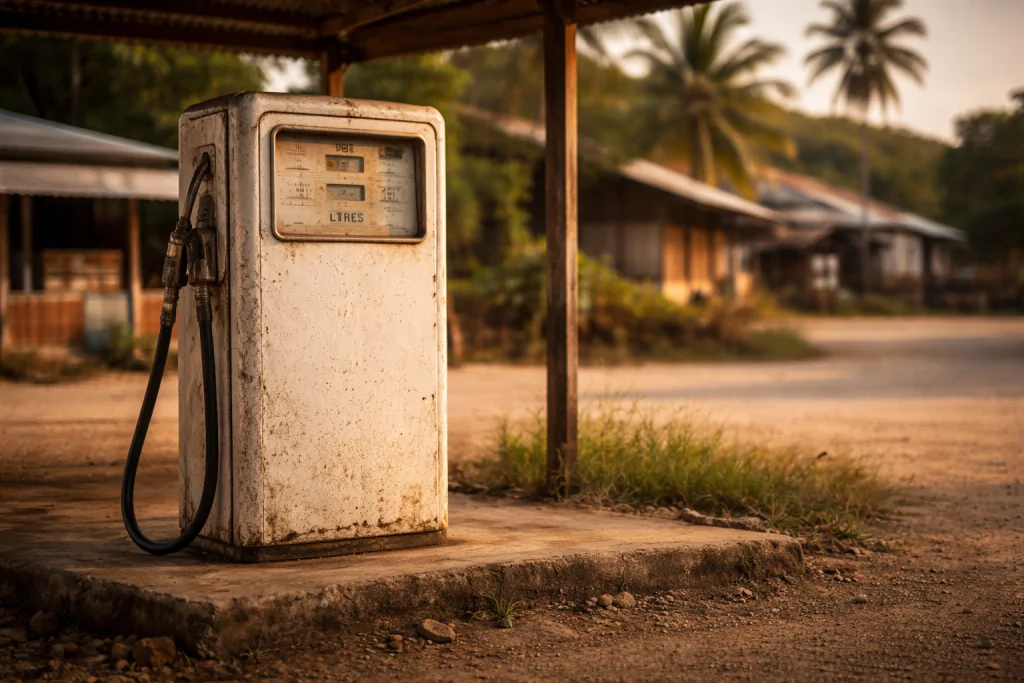
Just off to the side was what we kids called the bowser, or in our own way, baosa. To us, it was a place of fun. We’d save the last 20 toea from our lunch money, play games, laugh, and linger there until the very last moment before heading home.
It felt like an arcade.
A social corner.
A small escape.
Only years later did a quiet question surface:
Was bowser just a nickname – or was it something more?
What Was Here Before Us
While digging through the village’s history, I came across a detail that brought everything into focus.
In 1947, the two main Hanuabada communities, Poreporena and Hohodae, came together to form something remarkable:
The Poreporena and Hohodae Co-operative Society.
At the time, it was bold. A business owned, managed, and driven by the community itself. Not a government outpost. Not an outside venture. A collective effort built on trust and shared purpose.
By the 1950s, the Society was thriving.
Large freezers were installed to preserve food.
A branch store opened in Hohodae.
And most striking of all, a fuel pump was installed right in the village, supplying petrol to local truck owners and drivers.
That old white fuel pump I vaguely remembered near the bowser?
It wasn’t imagined.
It was real.
And suddenly, the name made sense.
What I had thought of as a childhood hangout had once been an economic hub, a place of movement, trade, and foresight, standing quietly beside the store that served the village.
Leadership You Could Walk Past
At the centre of this effort was the late Toua Kapena of Rahobada, a respected Hanuabadan and former Chairman of the Society.
I remember seeing him in his later years, not loud, not imposing, just a quiet presence that carried respect. He lived close to that area, which strengthens the belief that the Society’s main store, and the fuel pump, stood right there, or very near it.
The bowser wasn’t just a name born from habit. It was a name born from purpose.
In Motuan culture, names are rarely random. They describe function, place, and memory. They are shaped by what was done there.
That idea deserves its own chapter.
But here, it explains how a simple word carried an entire history inside it.
Even the Ending Was Ours
The Society eventually wound down around 1968. But even in its closing, it stayed true to its founding principle: for the people, by the people.
The man appointed to oversee its liquidation was Arua Udu Nou – a son of the village.
That choice matters.
It speaks to trust.
To accountability.
To ownership, even at the end.
Co-operative societies like this once existed across Papua New Guinea. They allowed communities to trade, save, and support one another with dignity. What made this one remarkable was its location – not in a district centre or government station, but right in the heart of Hanuabada.
What We Didn’t See as Children
It’s humbling to realise that as children, we played beside the legacy of something powerful without knowing it.
We saw the games.
The walls.
The shade of the bowser.
What we didn’t see was the story beneath it – of ownership, vision, and collective effort. Of our people stepping into commerce not as bystanders, but as drivers.
Today, we talk endlessly about community empowerment.
Yet decades ago, our elders had already shown us how it could be done, quietly and effectively.