Teamwork Makes the Dubu Stand

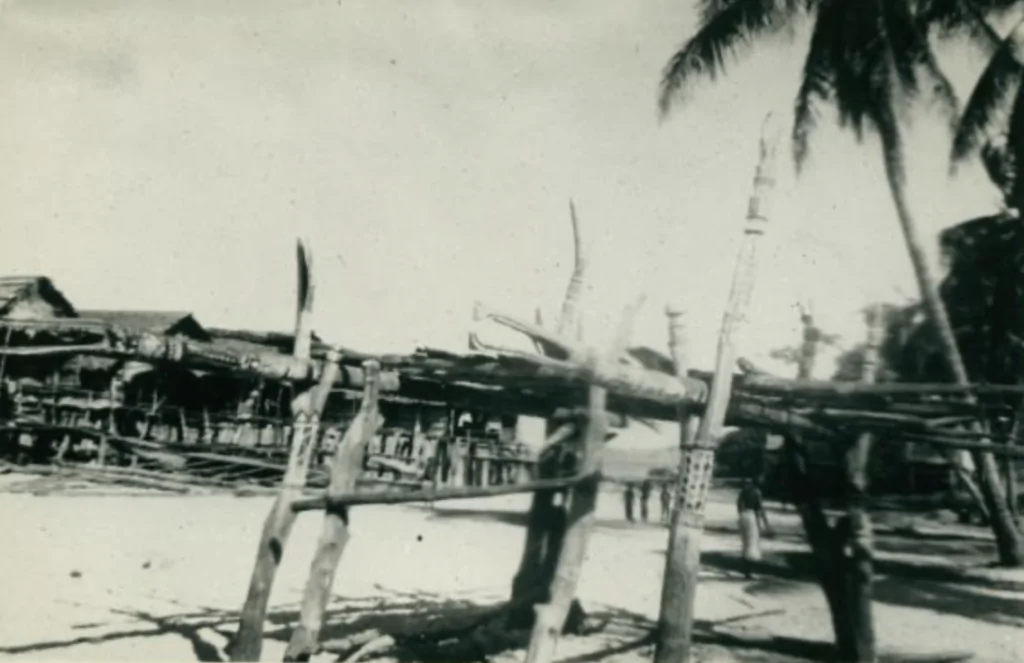
I was going through some old photos I took a few years ago when one image caught a friend’s attention.
My wantok looked at it closely and asked, almost puzzled, “Why did the organisers build such a small stage for an event this big?”
The photo was taken during the 2016 Hiri Moale Festival. Interestingly, not long after, I came across the Hiri Hanenamo winner from that same year on LinkedIn, she had recognised herself in a photo I’d posted of her dressed in fine traditional regalia. Small world.
But back to the question about the “stage”.
The truth is, what many people see as a stage isn’t a stage at all.
It is a dubu.
Understanding what a dubu is and why it exists opens a window into one of the most important values in Motuan culture: teamwork.
The dubu is a raised platform made from two carved beams resting on four carved upright posts. At first glance, it looks simple. Modest. Almost understated. But its meaning runs deep.
Each clan has its own distinctive carving patterns, etched carefully into the posts. These carvings are not decoration for decoration’s sake. They identify contribution, lineage, and presence. They tell you who stood where, and who stood together.
Traditionally, Motuans expressed their gardening prowess and social standing not through words, but through action. The dubu was the medium, the platform, through which that status was shown. In most cases, it was the clan chief who initiated its construction.
But here’s the important part: no one builds a dubu alone.
The process itself is a lesson in cooperation.
The instigator begins by carving and erecting the front right-hand post – the Idibana duhuna. This is the most important post. It represents leadership, initiative, and responsibility.
From there, the instigator calls on a supporter – someone willing to stand with him. That supporter carves and erects the front left-hand post, known as the Laurina duhuna.
The pattern continues. Supporters bring in others. Two more helpers are called to carve and erect the back posts – the Dura duhuna – and then the beams, known as Idikahana, are placed across the structure.
Only when everyone has played their part does the dubu stand complete.
And then come the singing and dancing – not as an afterthought, but as recognition. A celebration of collective effort.
What makes the dubu unique is that it never becomes the property of the originator alone. Once completed, it stands in honour of the entire clan. Every carved post acknowledges contribution. Every beam rests on shared effort.
This is Motuan teamwork in its purest form.
Leadership initiates, but community completes.
Even in its simplicity, the dubu carries powerful lessons that remain relevant today. It reminds us that visibility comes after collaboration. That status is earned through shared work. That structures, whether cultural, social, or modern are strongest when built together.
When we look at the dubu as just a “small stage”, we miss the point entirely.
It isn’t a stage.
It’s a reminder.
A reminder that long before project teams, committees, and organisational charts, Motuans understood how to work together, how to recognise effort, how to honour contribution, and how to build something meaningful as a collective.
Each of us carries stories from taim bipo, time before, that still have something to teach us about navigating the challenges of today.
The dubu stands quietly, but its message is clear.
Progress is never a solo act.